
The importance of chemical energy storage in the energy transition
Munich, 07 December 2023
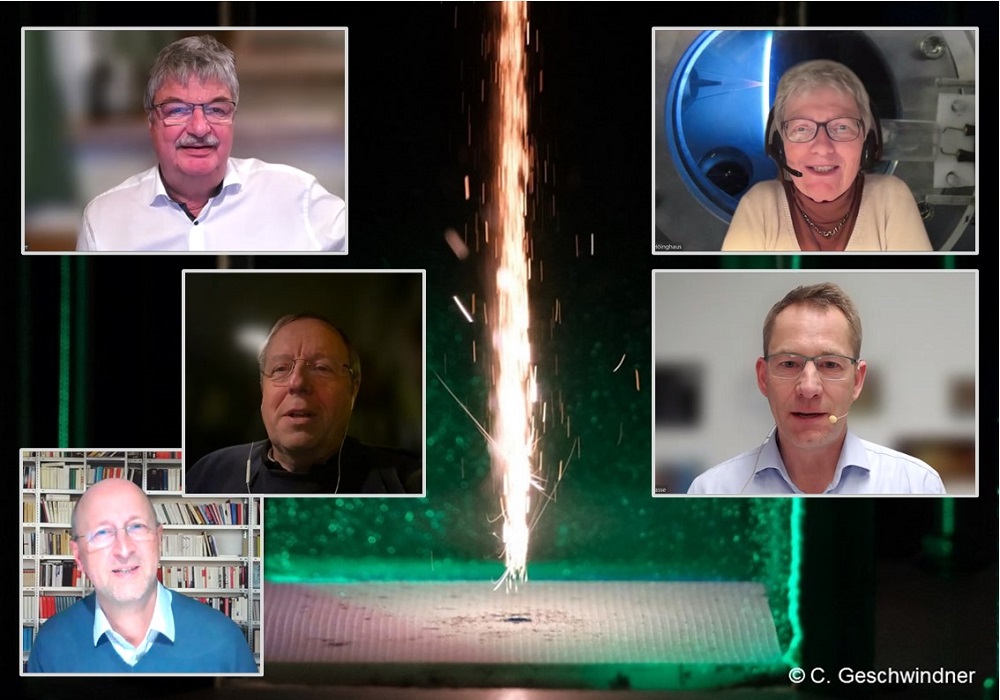
What part can chemical energy storage play in the energy transition? The focus is currently on hydrogen as the energy carrier of the future whereas iron as an energy storage medium is a relatively recent subject of debate. On 28 November acatech am Dienstag discussed chemical storage options as well as their technological maturity and efficiency. There was also discussion of the challenges facing basic research as well as transportation issues.
In his welcome address, acatech President Jan Wörner spoke about the consumption of primary energy which still comes primarily from fossil fuels, nuclear power and renewables. To completely switch the energy supply over to renewables, one thing is needed above all else: storage. The reason is that the electricity demand varies greatly over the course of a day and even over the course of a year. Also, the supply of electricity from renewables is very inconsistent when electricity generation is directly dependent on wind and sunshine. In such cases, there is a mismatch between power supply and demand.
Pros and cons of chemical energy storage
acatech member Katharina Kohse-Höinghaus, Senior Professor at Bielefeld University, gave examples of energy storage systems at the beginning of her talk: batteries, coal tips, fuel rods, gas caverns, tanks, pipelines and reservoirs. With the worldwide population growing, energy demand will increase in future – e.g. for generating electricity and heat, and for transport. For this reason, we must think about alternative methods of power generation and about new storage possibilities, said Katharina Kohse-Höinghaus. While there is a number of alternatives to primary energy from fossil fuels, there are relatively few transportation options at the moment.
By loading the video, you agree to YouTube’s privacy policy.
Learn more
Chemical storage systems are uniquely able to store large amounts of energy for a long time. However, energy conversion processes have to be taken into consideration. Katharina Kohse-Höinghaus pointed out the pros and cons of some chemical energy storage systems, as well as possible uses under discussion, which are summarised below.
Chemical energy storage systems: pros and cons, possible uses
Hydrogen (H2): Electrolysis
- Difficult to transport, high evaporation rate, flammability in the presence of O2, safety problems, indirect greenhouse gas
Use: Fuel cell, gas turbine, chemical industry, steelmaking.
Ammonia (NH3): Haber-Bosch process
- Large-scale production possible (using H2), transportation is established, toxic, inert, emissions: NO, NO2, greenhouse gas N2O
Use: Long-distance transport (ships), gas turbine (blended with H2).
Methane (CH4): Production requires H2 and a source of carbon
- Handling is a known quantity, greenhouse gas
Use: Heavy-duty transport, gas turbine, chemical industry.
Methanol (CH3OH), dimethyl ether (CH3OCH3) etc.: Production requires H2 and a source of carbon
- Handling is a known quantity, ideally in the liquid phase
Use: Fuel cell, diesel alternative, chemical industry.
Hydrogen as a chemical energy carrier
Maximilian Fleischer, Siemens Energy and member of the H2-Compass Sounding Board, stated at the beginning of his talk that it is becoming increasingly difficult to keep the German energy system stable: the more energy from renewables is fed into the electricity grid, the more inconsistent the supply. To illustrate his point, he went into the different capacities and timescales of the individual energy storage systems. One consistently important criterion is how much energy is stored and how much can be retrieved in the end. Batteries do very well, discharging 80 to 90 per cent of the stored electricity. However, they have a limited life. Many chemical energy storage systems have a longer life, but greater output losses. Unfortunately, we don’t have an ideal solution, said Maximilian Fleischer. Hydrogen is currently being produced on a large scale, and can then be converted into other chemical storage media, also on a large scale.
By loading the video, you agree to YouTube’s privacy policy.
Learn more
It is certainly possible to defossilise the entire energy system; that is, replace fossil fuels with renewable alternatives. However, the technologies required to do so must first be advanced and expanded to ensure their efficient and cost-effective use. There is no prospect of a silver bullet at the moment.
Iron as a chemical storage medium
Christian Hasse from the Technical University of Darmstadt underscored the huge importance of chemical energy storage in the energy transition.
By loading the video, you agree to YouTube’s privacy policy.
Learn more
Key points:
- The energy system of the future will require various energy storage systems.
- Metals are suitable for the long-term storage of large quantities of energy.
- Net-zero infrastructure upgrading is important to achieve the energy transition.
- Basic research and demonstrators together drive progress forward.
Metals – especially iron – have the following pros as chemical energy storage media: Iron has a high energy density, can be stored for long periods of time, is non-toxic, is not a critical raw material, is highly available and is easy to mine. Energy can be stored through carbon-free reduction (recycling) and withdrawn from storage through carbon-free oxidation (combustion). This can be compared to the charging/discharging of a rechargeable battery. A carbon-free circular economy on the basis of iron as an energy carrier can thus be created. One specific option is the net-zero upgrading of existing coal-fired power plants to replace coal with iron. Modifications would be required for the fuel feeding system, boiler and flue gas cleaning/dedusting, whereas steam generators and turbines could be reused. The thermal efficiencies are comparable to coal, emphasised Christian Hasse. Techno-economic analyses of overall efficiency and cost have confirmed the immense potential.
Further information
-
Contact

PD Dr. Marc-Denis Weitze
acatech - Deutsche Akademie der Technikwissenschaften
Leiter Kommunikation | Gesellschaft
Tel.: +49 89 520309-50
weitze@acatech.de -
Projects
Topic