
acatech study “New autoMobility” shows how Germany can achieve the mobility transition
Berlin, 05 December 2016
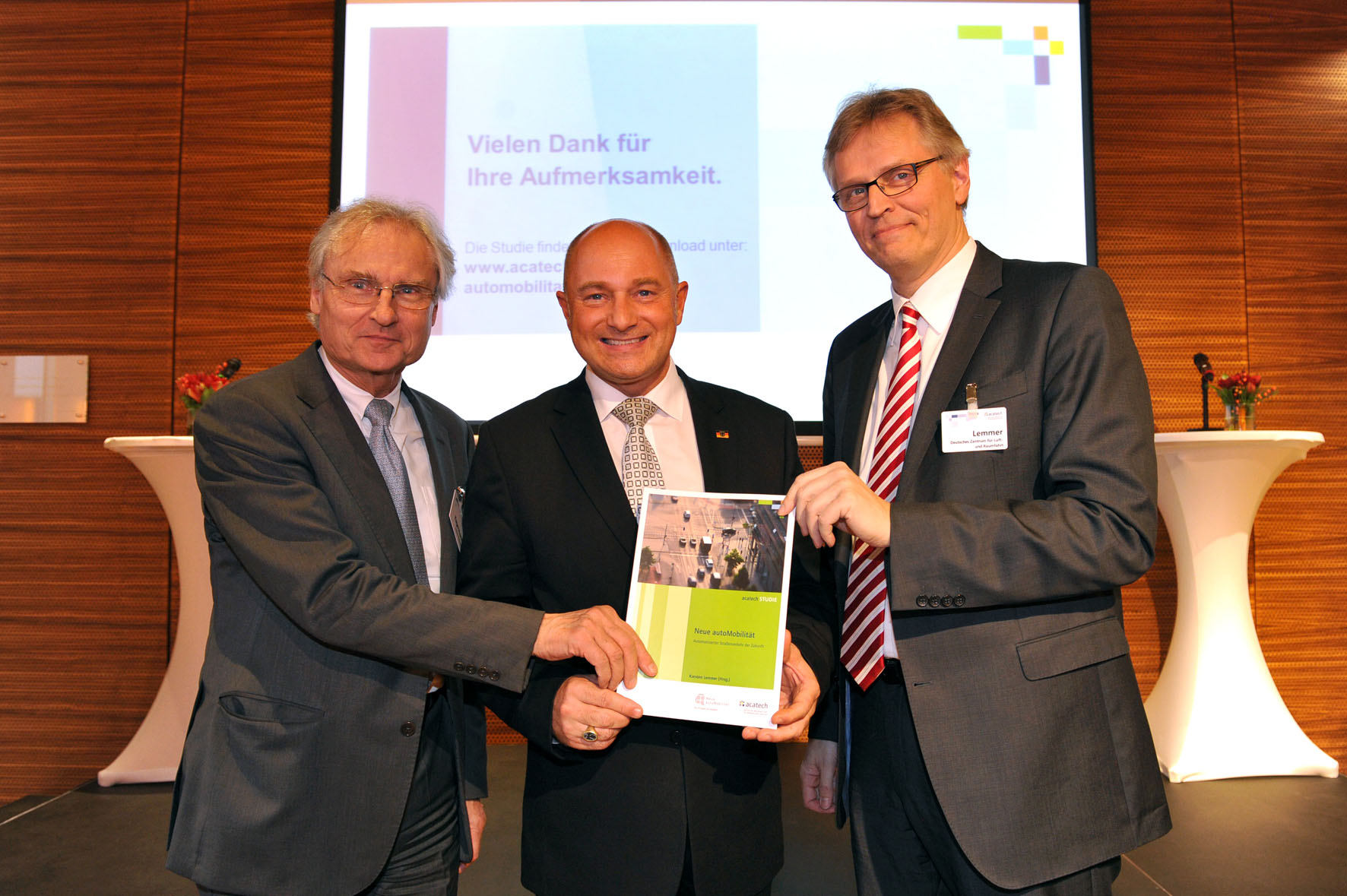
Today, acatech – National Academy of Science and Engineering publishes its “New autoMobility” study, which presents a roadmap setting out the steps required to achieve connected and automated road transport and traffic that improves both safety and traffic flows by 2030. The experts involved in the project employ concrete use cases to illustrate the benefits that automated driving could have for our society. As well as investing in infrastructure and research, Germany must also establish test beds in today’s road traffic environment. The report will be presented today at the Embassy of the Kingdom of the Netherlands in Berlin to Rainer Bomba, State Secretary at the Federal Ministry of Transport and Digital Infrastructure.
The study’s authors present a detailed target scenario for connected and automated transport and traffic in 2030 that will enable faster, safer and more reliable transport of people and goods. The different examples of automated driving each concentrate on a specific goal, such as improving road safety or better access to mobility. According to project leader and institute director at the DLR, Karsten Lemmer, “Here in Germany, we need to ramp up testing of connected and automated driving under the real-life conditions found in everyday road traffic. Test beds and living labs combine industry development projects with academic research initiatives, benefiting both parties. Moreover, if the test beds are able to demonstrate that automated road transport really can work, they will increase public confidence in the technology.”
However, establishing test beds it is not enough on its own – they also need to be centrally coordinated. This generates synergies by allowing the experience gained throughout Germany to be shared and utilised. It is also important to ensure that local authority traffic planners are involved in the test beds. In the words of acatech President Henning Kagermann: “Automation and connectivity – together with electrification – are the key pillars of the forthcoming mobility transition. As well as developing the appropriate technology, it will also be necessary to update the regulatory framework, for example the Road Traffic Ordinance and type approval law. As a leading automotive nation and pioneer of Industrie 4.0 and the energy transition, Germany has a responsibility to accelerate the transition to connected, automated electric mobility.”
The Academy’s experts have identified a particular need for further development of the technology in the fields of human-machine interaction and vehicle-to-infrastructure connectivity. The combination of automation and digital connectivity promises to revolutionise road transport and traffic in the future. Software is playing an increasingly important role in controlling vehicles – modern vehicles process, share and rely on larger and larger quantities of data. This data can be used to optimise increasingly intelligent road traffic, thereby reducing congestion and emissions. Meanwhile, opportunities are arising to establish new, data-driven mobility services such as autonomous shuttles, which are especially useful for people who can’t drive or don’t wish to own a car. However, the study also emphasises that data protection regulations must be updated in order to safeguard the right to informational self-determination and principles such as the purpose limitation of personal data.
The study’s authors, who worked together in acatech’s cross-sectoral, interdisciplinary “New autoMobility” project group, were drawn from over 40 organisations in academia, industry and civil society. Their study hopes to bring some clarity to a hitherto rather confusing debate.